
Publications archive
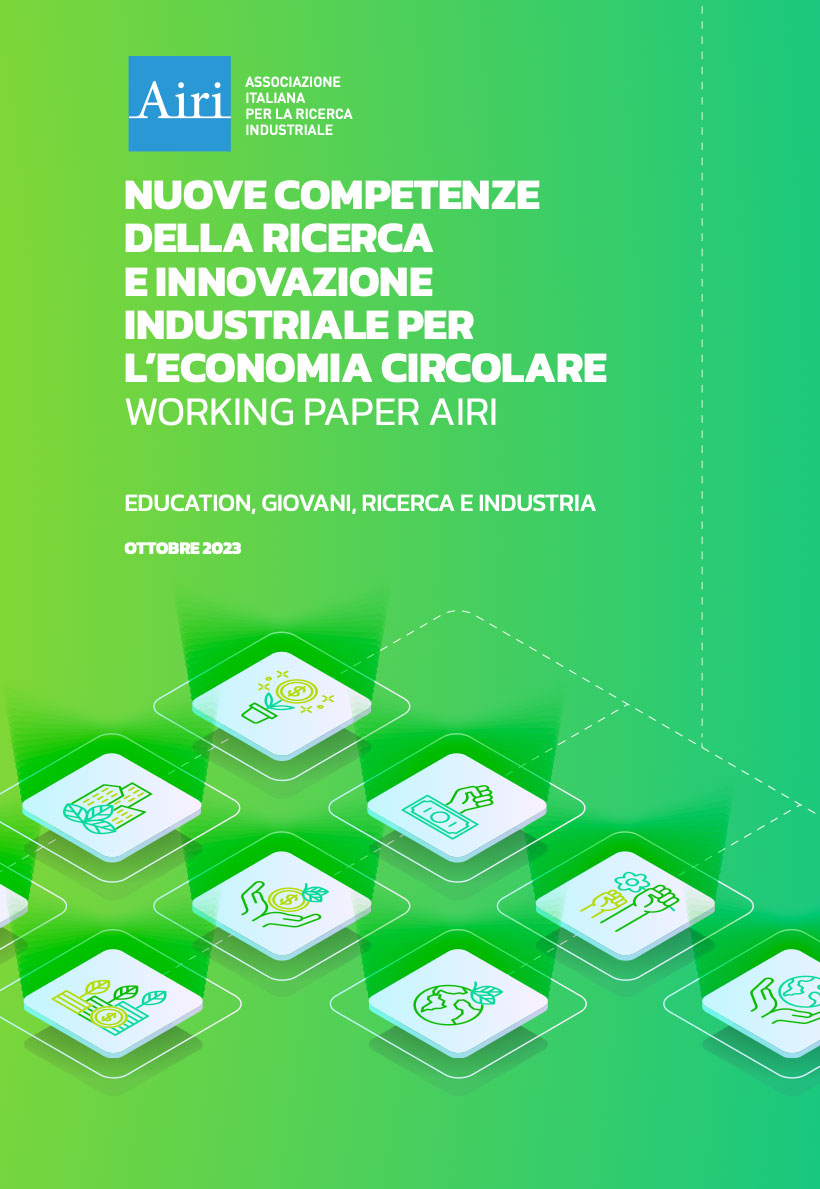
Working paper Airi: New skills for research and industrial innovation for the circular economy
 STEM Skills
Gruppo di lavoro Airi Education, Giovani, Ricerca e Industria, Pirelli (Coordinamento), Bracco, Federchimica, Fincantieri, Italcementi, Lfoundry, Smilab, Ayming, CRS Laghi, Lapetre, Service Group R&D, Enea, Scuola Normale Superiore, Chilab-Politecnico di Torino, Università di Pisa
The working paper New Skills for Research and Industrial Innovation for the Circular Economy, developed by the AIRI working group “Education, Youth, Research, and Industry” highlights how the energy and digital transition also responds to a generational transition process, which expresses new needs for social and environmental responsibility.
We believe that this work is useful for schools and universities to focus on new curricular paths aimed at bridging the skills gap identified with the onset of the digital and green transition. A gap already analyzed in the first working paper by AIRI New Digital and Green Skills in Industrial Research and Development from 2022.
From the two works, a multifaceted picture of the professional skills that companies wish to acquire emerges.
This latest work outlines more concretely the new organizational arrangements and the new professional roles introduced by companies, demonstrating how the transition to net-zero emissions can translate into new professional skills in R&D.
Research and innovation can provide significant support for the decarbonization of the production system by translating ESG criteria (Environmental, Social, Governance), the requirements set by the body of European regulations, and sustainability standards into production models and industrial practices.
Virtuous case studies from Airi Members
Pirelli, Heidelberg Materials Group, Italy Cement, Smigroup-Smilab, Lapetre have been identified as concrete examples of the new organizational governance, which includes circular reorganization processes.
Furthermore, recommendations have been defined to outline new training pathways for R&D personnel in the circular economy. The recommendations are drawn from interesting case studies from the public sector: the experiences of ENEA regarding the awarding of "research grants" on the multiple aspects of the circular economy and those of the University of Pisa for the reskilling of personnel.
The underlying virtuous principle is to connect R&D and Innovation, product and process study with market feedback, initiating the necessary transformations of the product life cycle and consumption habits, and formulating new business models.
You may also be interested in the following publications:
-
book_2 RRI in Italy 2019