
Publications archive
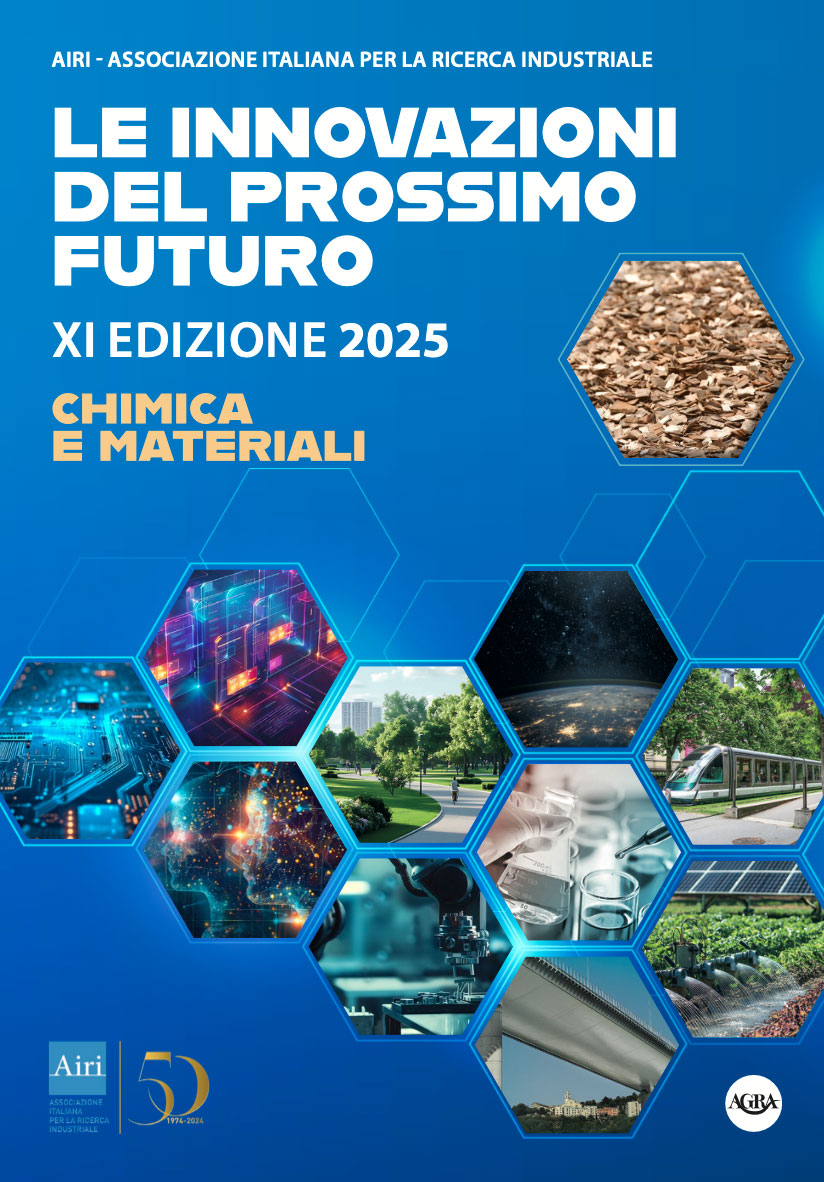
The Innovations of the Near Future - Chemistry and Materials
 Priority Technologies
AIRI con il coordinamento di FAST e CNR-SCITEC, e la collaborazione di Federchimica, ARCHA, CLARIANT Prodotti Italia, CNR ISSMC, ENI, Innovhub-SSI, Mapei, Pirelli, Politecnico di Milano, Politecnico di Torino, Università di Pisa e Versalis.
The document explores technological scenarios in the chemical and materials sector, highlighting the strategic role of chemistry for the economy and environmental sustainability.
At the national level, the chemical sector is the fifth industry by revenue; at the European level, the Italian chemical industry is the third in terms of production value (over 67 billion euros) and number of employees (over 113 thousand). With over 2,800 production sites and almost 113 thousand highly skilled employees, Italy is the third largest chemical industry in Europe in terms of production and employment. The sector has already achieved significant milestones in adopting eco-friendly processes and reducing environmental impacts, investing in circular chemistry and biomass.
- Published: May 2025
- PP: 184
- Agra Editrice
- ISBN 978-88-98935-73-4
The volume is edited by AIRI with the coordination of FAST and CNR-SCITEC, and the collaboration of Federchimica, ARCHA, CLARIANT Products Italy, CNR ISSMC, ENI, Innovhub-SSI, Mapei, Pirelli, Politecnico di Milano, Politecnico di Torino, University of Pisa and Versalis.
The document explores technological scenarios in the chemical and materials sectors, highlighting the strategic role of chemistry for the economy and environmental sustainability.
At the national level, the chemical sector represents the fifth industry by turnover; at the European level, the Italian chemical industry is the third for production value (over 67 billion euros) and number of employees (over 113,000).
With over 2,800 production sites and nearly 113,000 highly qualified employees, Italy is the third largest chemical industry in Europe by production and employment. The sector has already achieved important milestones in adopting ecological processes and reducing environmental impacts, investing in circular chemistry and biomass.
The competitiveness, however, also depends on external factors such as the regulatory context, industrial policies, and European strategies.
Skills play a crucial role: according to Federchimica, the share of degree holders in the sector is 27%, nearly double the industrial average (15%). Youth employment has increased by 19% between 2015 and 2022, well above the +8% of the manufacturing industry.
The future challenge is to find personnel with digital and green skills.
Research is increasingly moving towards a model of open innovation and public-private collaboration: 14% of Italian chemical companies collaborate with universities and research centers, a share higher than the national manufacturing average (5%) and close to the European sector average (17%).
This model requires a complex and managerial management of research, to plan, finance, and monitor innovative projects with medium to long-term returns. Furthermore, public research must strengthen its role, not only in synthesis chemistry and polymers but also in formulations, maintaining proactive dialogue with companies.
TECHNOLOGICAL SCENARIOS
EFFICIENCY AND SUSTAINABILITY OF PROCESSES
- Electrochemical processes for the synthesis of basic chemicals
- Synthesis of new renewable bisphenol A substitutes for various application sectors
- Catalysts for the reduction of nitrous oxide (N₂O)
- Valorization of CO₂ to chemicals and fuels
EFFICIENCY AND SUSTAINABILITY OF MATERIALS AND PRODUCTS
- Innovative materials for energy storage systems
- Chemical functionalization of smart sensors for selective detection
- “Eco-friendly” materials for wind turbine blades: vitrimer and other thermo-responsive resins
- Secondary materials and new additives for concrete
CIRCULARITY AND RECYCLABILITY OF PROCESSES AND PRODUCTS
- Chemical recycling of plastics
- Technologies and materials for the circularity and reuse of multi-material products, including tires
- Technologies for introducing biopolymers in high-performance tires
- Functional additives for sustainable solutions
- Development of compostable/recyclable packaging functionalized with active ingredients from waste biomass
- Upcycling of silverskin, the residue from coffee roasting