
 Research and Innovation
Collaborating to innovate: workshop on sustainable construction technologies
Last May 25, in collaboration with the Leonardo da Vinci National Museum of Science and Technology, a networking meeting was held between representatives of research bodies, industries and institutions, dedicated to innovation in the building and construction sector.
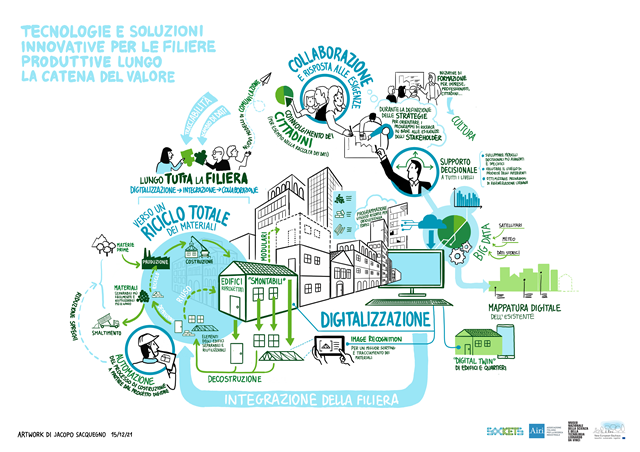
The meeting represented a further step forward compared to the results achieved in the Italian SocKETs Lab, in which, through a participatory process, the possibility of introducing enabling technologies into the construction and construction sector was discussed, with circular economy approaches.
During the event, the SocKETs guide dedicated to supporting companies and research organizations in concretely implementing participatory and co-creation processes was also presented and discussed.
Participatory processes and co-creation
From 2021 to today, the over 50 stakeholders and 30 citizens involved from manufacturing industries, service companies, sector professionals, trade and worker representatives, third sector associations, research centers and universities and institutions, inhabitants of some city neighborhoods have been bearers of knowledge, experiences and objectives, but also of fearful expectations on the innovations for construction and urban regeneration achievable through Key Enabling Technologies.
Two scenarios emerged from this comparison:
The first scenario describes how automation technologies can lead to the industrialization of production processes and therefore to a reduction in time and waste.
The second scenario concerns the diffusion of innovations in buildings and cities, with a direct impact on the lives of citizens.
The protagonists of the workshop
The event held last May 25th highlighted common interests and areas of collaboration between representatives of:
ANCE Lombardia, regional association of Lombardy building constructors, CETMA (European Research Center for Design Technologies and Materials), Colorobbia Consulting, The INTEGRA Consortium, Deloitte, ENEA (National Agency for new technologies, energy and sustainable economic development), Federcostruzioni and the project DIHCUBE, there Piedmont Innova Foundation, Habitech and the project Greenmap, Italcementi, The Polytechnic of Milan (Dept. of architecture, construction engineering and built environment), Trilateral Consulting, the'University of Turin, the'Polytechnic University of Marche and the platform ECTP, Webidoo.
In particular, the experts involved agreed on:
The opportunities offered by advanced materials and new production systems to develop more efficient, safe and sustainable buildings. Systems for restoring and renewing existing materials, smart materials and self-repairing materials, high-quality prefabricated systems, reuse of recycled and biobased materials are some examples of innovations. Greater industrialization of processes and products, optimization of value chains, circular economy are among the drivers of change.
The imperative of digitalisation, towards both the efficiency of existing processes and the development of completely new models of process organization, from 3D construction techniques, to digital twins, to blockchain for the sharing and exchange of materials and data between actors in the supply chain and also between end users (including citizens), to artificial intelligence and decision support systems for urban planning.
The development of new synergies, the collaboration as a lever to create innovative solutions, creating multidisciplinary and multi-sector networks, developing industrial symbiosis processes, from an innovation ecosystem perspective.
There are several examples of network approaches and collaborative initiatives underway at national and European level discussed at the table, come on digital innovation hub al new European Bauhaus. Research funding opportunities in the sector are important, from Horizon Europe, to the Life programme, to PNRR funding, national research and enterprise can play an important role.
Social involvement
Social involvement is fundamental to guarantee fair and shared development. Citizens must not only "be informed", but must be actively involved in guiding industrial and public policies, with their own skills and knowledge.
If universities, research centers, companies, associations and the media are able to communicate the value of innovation with stakeholders and citizens, the transformation of a traditional sector, such as the construction sector, with deep-rooted traditional approaches, could occur more easily.
The Guide
The SocKETs experience is contained in one guide for the creation of supporting participatory processes ofinnovation, a simple and direct manual aimed at companies, associations and other organizations involved in research in KETs: the SocKETsTech Guide:responsibletechinnovationusingsocietalengagement.
The Guide, based on six pilot experiments of societal engagement and co-creation, linked to the themes of health, industrial automation and circular economy made by SocKETs, aims to be a source of information for the world of industry and for innovators who aim to involve citizens in the development of technological innovations.
Cavailable for free online And also downloadable.
The online exhibition
Online there show Let's Tech Together!, which tells the relationship between innovation and society and mutual influences, as well as offering an overview of the results of the various SocKETs Lab, including that one Italianor on the topic of sustainable construction technologies.
Read also: The Sockets project
You may also be interested in the following content:
-
brand_awareness Call for "Stories" on citizens, technologies and innovation
-
brand_awareness Enabling technologies for the circular economy in construction
-
brand_awareness SocKETs: Societal Engagement with Key Enabling Technologies