
 Research and Innovation
Smart Building Architecture: innovative solutions for safe and sustainable construction
At the level European, The sector of the building and construction vand the use of beyond 18 million workers and contributes approximately 9% of GDP. AND the first sector for useor of raw materials (beyond 40% ofuse total) Andd is responsible by more than a third del consumptionor finethe dthe energito global. Historically it has always been characterized by limited use of technologistsAnd innovative, but in recent years construction and architecture are providing increasingly innovative solutions to develop the so-called "Smart Building Architecture".
Webinars Construction & Architecture: building safe & smart
How to get there reduction dthe CO2 in production processes? How to prevent climate and environmental risk? How to introduce more efficient and sustainable energy systems?
These and other questions were addressed during the webinar Construction & Architecture: building safe & smart, one of the 9 webinars organized for the 4th edition of Tech Collider 2023, dedicated initiative to the matching between Public Research and Business.
The Airi contribution: two innovation scenarios for a circular future of building and construction
Researchers are working on technologies that ensure a tailored "user-experience" by designing, for example, more efficient and safer buildings or building systems to reduce energy consumption.
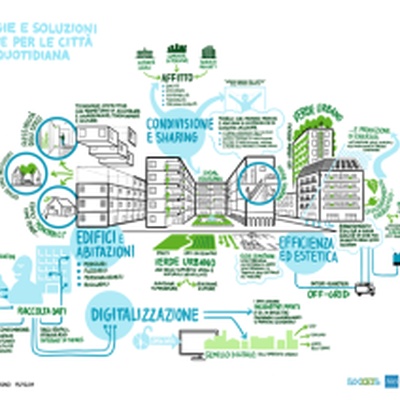
Airi showed the results of the SocKETs Lab Italian, an initiative that involved researchers, businesses, institutions and citizens to discuss innovations for the circular economy in the sector.
The case study defined two innovation scenarios for a circular future of building and constructioni: the first concerns the diffusion of innovations in the value chain and along supply chains connected to it; the second the diffusion of innovations in buildings and cities, with a direct impact on the lives of citizens. The innovative results of the project will be soon presented to citizens also through a exhibition at the L. Da Vinci Museum of Science and Technology in Milan and are already available to everyone in virtual format (show SocKETs).
The investors' point of view
The innovation scenarios presented by Airi also proved to be in line with the needs of the construction sector illustrated from Anna Amatidi Eureka! Ventures, which brought the point of view of investors, in favor of the promotion and support of new ideas and innovations, in a context characterized by a lack of propensity for innovation, by a fragmentation of the production context, by stringent regulatory regulation and by other socio-economic obstacles.
The Experiences of Proof of Concept
The focus of the event was the consequences and feedback from the most interesting projectsthe Proof of Concept (PoC), carried out through the DGTPI-UIBM tender. Four different PoCs presented in the webinar:
Control-Tech, presented by Francesco Tondolo of Polytechnic of Turin. The device is composed of reinforced bars containing sensors to comprehensively control tension and temperature of a structure. It is quick and easy to install, low-cost and suitable for both new and pre-existing structures, guaranteeing their safety by constantly monitoring their status.
NSHT (New Smart Hybrid Transducer), presented by Martina de Cristofaro And Renato Zona of theUniversity of Campania Luigi Vanvitelli. This monitoring technology consists of a distributed strain transducer for structural and geotechnical applications. Among its main strengths, it enjoys good ease of transport, adaptability to the substrate, and is suitable for installations over long distances.
In-Sharp, presented by Giulia Pezzullo And Antonella Falzetti of theUniversity of Rome Tor Vergata. It is an innovative construction system capable of guaranteeing modularity and flexibility of spaces for microarchitecture, thanks to easily assembled prefabricated structures. Furthermore, the possibility of reusing the modules created and their individual components is of great interest.
HySAFE, presented by Walter Lacarbonara And Biagio Carboni of theLa Sapienza University of Rome. It is a new system of oscillating masses for the protection of multi-storey buildings from earthquakes and winds. Among the most interesting aspects, the direct energy demand of the control system is zero, while the minimal space and time requirements for installation reduce the architectural and economic impact.
These technologies have all reached at least Proof of Concept and must therefore advance along the Technology Readiness Level scale, taking into account the market they are targeting, the stakeholders involved and the competitors. To reach the final application and market entry, it will be important to involve professionals from different disciplines, not only scientific but also economic, in order to analyze the different factors at play to define an effective market strategy.
Conclusions
Attendance at the webinar was wide and he saw representatives of research and industry confront on needs and prospects of the sector. From these opportunities for discussion emerges as such complex issues require strong public-private collaboration e a'high multidisciplinarity. If on the one hand the world of research should open up to economic and entrepreneurial culture, on the other hand the construction sector should open up to innovation.
You may also be interested in the following content:
-
brand_awareness Call for "Stories" on citizens, technologies and innovation
-
brand_awareness Enabling technologies for the circular economy in construction
-
brand_awareness SocKETs: Societal Engagement with Key Enabling Technologies