

 Research and Innovation
Cities in 2030: vision and problems to solve
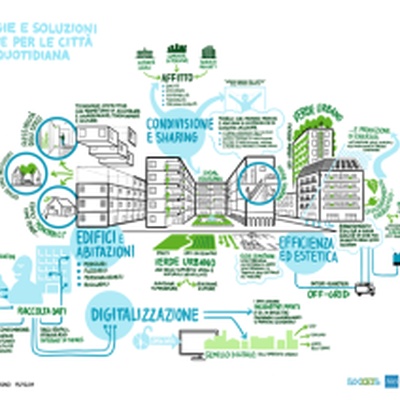
What will our cities be like in 2030 and what problems will be a priority to solve?
This is the last topic addressed by some experts in the series of meetings dedicated to sustainable construction technologies of SockETS Lab Italian.
We listened to the point of view of Edoardo Zanchini (Legambiente), Pierfrancesco Maran (Councillor of Municipality of Milan), Sara Grassi (National Association of Building Contractors – ANCE – Lombardy) and Stefania Striato (Green Building Council Italy – GBC), with whom we had already spoken about construction and energy costs, del need for new rules and of theimportance of participation.
Numerous issues to address
Sara Grassi of ANCE poses as the main problem that of improvement of transport, both internal to cities and external, to connect them to their hinterland. Furthermore, interventions are necessary urban regeneration, to increase citizens' sense of belonging to their neighborhood and city.
Edoardo Zanchini of Legambiente indicates the sustainability, as the only way forward for 2030, in all problem areas. Energy consumption, waste and material management and, of course, transport. In particular, mobility must be public, integrated with sharing and with cycle and pedestrian paths.
Stefania Striato of GBC talks about cities that will have to be more resilient. Buildings and urban planning they must be rethought to mitigate and address them in a more structured way the impact of climate change and rising temperatures. Cities will have to offer citizens more open, comfortable, shaded and green spaces, which mitigate the urban microclimate. Furthermore, they will provide the materials they need themselves: not only the buildings, but also the underground infrastructure will be material banks.
From above and below
To all these changes "from above" we need to add behavioral ones on everyone's part, for example starting to think of cities themselves as resources of materials that can be used in the future for other construction sites. The Councilor of the Municipality of Milan Pierfrancesco Maran gives the post-pandemic situation in Milan as a positive example: over 4000 commercial activities have occupied pavements and streets with their outdoor areas, while cyclists have increased by 40/50%. It is an epochal change in public space, which would not have happened only with an infrastructural investment: the citizens' mentality has changed.
It is easy to imagine the cities of 2030 as new places, investments and great works, but what has a widespread impact on people's mentality will probably have a more positive and lasting effect.
All information about the project SocKETs
Read also:
The results of the second Italian SocKETs Lab on sustainable building and construction
Marco Iuorio: innovations for the circular economy in the building and construction sector
Giovanni Spatti: innovations for the circular economy in the building and construction sector
Construction and energy costs: what impacts and opportunities?
Innovations and sustainability in construction: new standards are needed
Participation is fundamental to the future of construction
You may also be interested in the following content:
-
brand_awareness Call for "Stories" on citizens, technologies and innovation
-
brand_awareness Enabling technologies for the circular economy in construction
-
brand_awareness SocKETs: Societal Engagement with Key Enabling Technologies