 Research and Innovation
Innovation scenarios for a circular future of building and construction
The results of SocKETs Lab Italian
The last phase of the project has just ended SocKETs Lab Italian dedicated to innovations for the circular economy in the building and construction sector.The involvement and co-creation activities developed in the SocKETs Lab starting last year (2021) have made it possible to collect and integrate not only the knowledge, experiences and objectives, but also the fears and expectations of the stakeholders and citizens involved.
The participatory process, in fact, involved around 30 citizens and over 50 stakeholders from: manufacturing industries and service companies, professions, trade and worker representatives, third sector associations, research centers and universities and institutions.
Two scenarios for innovation in the sector emerged from these activities:
- the first scenario concerns the diffusion of innovations in the value chain and along supply chains connected to it;
- the second concerns the diffusion of innovations in buildings and cities, with a direct impact on the lives of citizens.
The first scenario
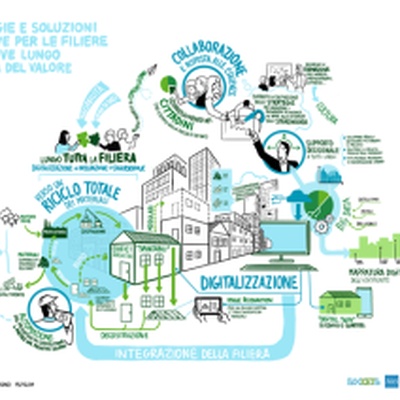
The first scenario describes how automation technologies can lead to the industrialization of production processes and therefore to a reduction in time and waste, also allowing the spread of "dry" techniques. This will increasingly facilitate the selective deconstruction and reuse of components.
Technologies to improve the sorting and traceability will instead allow for the almost total recovery and recycling of materials, while digitalisation will lead to digital twins (virtual simulation of processes and systems), both on the scale of the building and on larger scales (neighbourhoods, cities).
This, combined with more intense and rapid collaboration with professionals and users, will make it possible to collect enormous quantities of data and exploit the potential of artificial intelligence to support decision-making processes (on maintenance, urban regeneration, energy consumption, etc.) and plan the use of resources more efficiently, also thanks to the greater possibility of integrating production processes, also with a view to symbiosis.
The second scenario
The second scenario describes how life can be transformed in the cities of tomorrow. New energy technologies, new materials and digitalisation, combined with the use of greenery and other solutions that exploit natural processes, will guarantee energy efficiency and the possibility of increasingly optimizing consumption based on the needs and habits of citizens. Digital technologies will also allow the maximum diffusion and optimization of sharing models, starting from spaces in buildings (e.g. evolution of social housing), to services, up to Renewable Energy Communities for the sharing of self-produced energy.
Thanks, for example, to the possibility of having greater modularity in the construction elements (walls, systems, etc.) it will be possible to easily and cheaply modify the organization of the spaces of buildings and environments and guarantee greater customization and flexibility of use over time.
The possibility of collecting data on buildings and therefore on the needs, habits or critical issues detected by citizens will allow action to be taken to monitor and improve performance, consumption or services or to stimulate the diffusion of good practices. This will also be possible thanks to the creation of true digital twins of buildings.
Co-creation methodologies and participatory processes
The introduction of technologies in a pervasive way raises fears and doubts, both among the stakeholders involved and among citizens, but co-creation methodologies and participatory processes, such as the one experimented in SocKETs, allow us to define operational proposals (be they scenarios for innovation or actual innovative products) desirable and which guarantee greater benefit to all those involved.
The active co-creation of processes mutual learning, cross-fertilization increases the awareness of all the actors involved, generating shared value which remains for anyone who participated, regardless of the sector in which these methodologies are developed.
Read also:
The results of the second Italian SocKETs Lab on sustainable building and construction
II Italian SocKETs Lab: Scenarios for innovations in the building and construction sector
Circular economy in the building and construction sector in Italy – Meeting citizen's expectations
Co-creation workshop, enabling technologies for sustainable construction – on Greenplanner
Report on the innovation ecosystem
Innovations for the circular economy in the building and construction sector - the Italian SocKETs lab
You may also be interested in the following content:
-
brand_awareness Call for "Stories" on citizens, technologies and innovation
-
brand_awareness Enabling technologies for the circular economy in construction
-
brand_awareness SocKETs: Societal Engagement with Key Enabling Technologies