

 Priority Technologies
The 3 technologies that will change our lives: the results of the TechEthos horizon scan
Airi and the project TechEthos have carried out, in collaboration with international experts, a horizon scan study to identify emerging and enabling technologies with high socio-economic impact and with relevant ethical and social implications. Among the 16 technologies selected, three were identified to develop operational guidelines for the evaluation of ethical and social impacts.
These are technologies that are being developed, or will be developed in the short-medium term in Europe and around the world, and from which disruptive effects are expected on the economy, the environment and the way we live.
The technologies
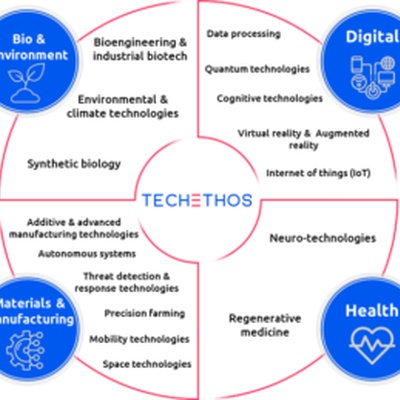
From an initial list containing 35 families of technologies with a high socio-economic impact, with important ethical and social implications and of relevance for the objectives of the project, have been identified 16 (divided by research sector: Bio and Environment, Digital, Health and Materials and Manufacturing):
The 16 families of technologies
Climate and Environmental Engineering
Industrial bioengineering and biotechnology (excluding healthcare)
Synthetic Biology
Data processing technologies
Quantum Technologies
Internet of Things (IoT)
Cognitive and behavioral technologies
Virtual Reality (VR) and Augmented Reality (AR)
Regenerative medicine
Artificia human/neuro-technologies
Technologies for advanced and additive manufacturing
Autonomous systems
Threat detection and response technologies
Precision agriculture
Mobility technologies
Space technologies
The three families chosen
Among these 16 families of technologies, the TechEthos project to develop guidelines for the management of ethical-social impacts has decided to focus on three families of technologies:
Climate Engineering
Digital Extended Reality
Neuro-technologies
Methodology
For the identification of emerging and enabling technologies and the qualitative assessment of socio-economic impacts, numerous documents published by public institutions, European and international projects, European and international research centers and consultancy firms were examined, including: OECD, WEF, European Commission, MIT, NATO, and consultancy firms such as Gartner, Frost & Sullivan, Deloitte and others.
A panel of over 70 researchers and experts from research centers, industries and institutions in 21 countries was also involved, with multi-disciplinary skills in the natural sciences and human sciences and in particular in the fields of advanced technologies, technology assessment, ethics, analysis of legal and economic impacts. The involvement of experts allowed the validation of the technologies and the potential ethical, social, legal, industrial, economic and policy impacts of the identified technologies.
The TechEthos project will now focus on the three families chosen to evaluate in depth their ethical-social, political and legal impacts, through further analysis and discussion with all stakeholders (research, industry, institutions, civil society and citizens).
The ultimate objective of the project is to facilitate ethics-by-design approaches, i.e. integrating ethical and social values from the early stages of technology design and development.
TechEthos will therefore develop operational guidelines for the ethical evaluation of emerging and enabling technologies, starting from the case studies relating to the three families of selected technologies (Climate Engineering, Digital Extended Reality, Neuro-technologies)
For further information
TechEthos Report: New and emerging technologies with high socio-economic impact
TechEthos videos
Download:
FactSheet Climate Engineering
FactSheet Extended Digital Reality
FactSheet Neurotechnologies
You may also be interested in the following content:
-
brand_awareness Priority Technologies: a unique foresight at the national level
-
brand_awareness Extra-mural R&D in 2014 grows to 2.4 billion euros
-
brand_awareness Three calls for research projects in Argentina