
 Priority Technologies
Emerging enabling technologies: the Italian panorama
The HORIZON 2020 Program was without a doubt the main instrument that allowed an adequate level of development of Key Enabling Technologies (KET) in European countries and, particularly, in Italy.
The Italian Research and Innovation System has always been characterized by a particular fragmentation: a marked individualism and a limited propensity for cooperation, factors which, obviously, also make the process of technological transfer from the Research System to the Innovation System complex. With reference to the KET sector, the push of HORIZON 2020 has helped to partially overcome this criticality, generating public-private collaborations of particular relevance. This is also thanks to some national initiatives which have welcomed the KETs into programming and aligned the strategic objectives with those of HORIZON 2020 (Fig. 1):
[caption id="attachment_16452" align="aligncenter" width="772"] Fig.1 Italian initiatives that include Enabling Technologies (KET)[/caption]
For example, in reference to the area of Smart Specialization Strategies, the relationships between the KETs and the strategic objectives are evident from Table 1, as in the case of the Emilia Romagna Region in the AgriFood sector.
[caption id="attachment_16453" align="aligncenter" width="750"] Tab 1 - relationships between the KETs and the S3 strategic objectives[/caption]
Under the overall push of these actions, the Italian Research and Innovation System has developed substantially along three directions:
1. Adaptation of the educational path of graduates and permanent training of workers;
2. Development of the competitiveness of the industrial system. If we consider for example the Transport Area, the fundamental objectives can only be achieved through an appropriate combination of Enabling Technologies (Fig.2)
[caption id="attachment_16454" align="aligncenter" width="750"] Fig.2 - KET and Transport Area[/caption]
3. Ensure the social impact of R&I results. According to ISTAT, out of a sample of 400,000 companies, 52.3% can be defined as non-sustainable, 15% slightly sustainable, 15.1% on average sustainable and 17.6% highly sustainable (Table 2)
[caption id="attachment_16455" align="aligncenter" width="750"] Tab 2 - Sustainable companies and productivity[/caption]
The consideration regarding productivity is very interesting: in relation to companies with zero sustainability, taken as a reference, we observe a increase in productivity as sustainability increases.
This result is also due to the significant participation of Italian organizations, both public and private, in the themes of HORIZON 2020, including NMBP and others such as Science with and for Society.
The NMBP funding program therefore had the role of generating a change in the culture of Italian actors in Research and Innovation, promoting not only a growth in specific skills, but also a satisfactory awareness of the need to address and integrate the economic, environmental and social aspects of Innovation.
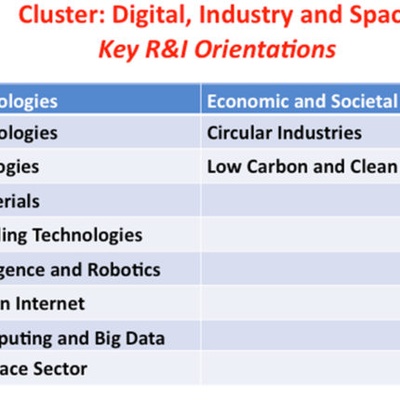
Can this wealth of skills and approaches be enhanced and capitalized within the next Horizon Europe Program and specifically in the area of Pillar 2: Digital, Industry and Space? Considering the priority orientations of R&I in the new program (Fig.3), the answer can only be affirmative.
[caption id="attachment_16457" align="aligncenter" width="750"] Fig. 3 - R&I orientations in “Digital, Industry and Space”[/caption]
Specifically, there are two issues of particular relevance for Italy:
a) The first concerns digital technologies and in particular the development ofArtificial intelligence, which in the Italian vision is always approached with an anthropocentric vision. The main industrial interests concern the following sectors:
- Pharmaceutical Industry (Drug Discovery, Drug Delivery and Clinical Applications);
- Automotive Industry (Autonomous Driving, Predictive Maintenance, Cyber Car, Connected Supply Chain);
- Microelectronics (Smart Driving, Smart Industry, Smart Home and Smart Things);
b) The second is related to the good Italian position in the field of Advanced Materials. Starting from the consideration that the development of technologies for renewable and sustainable energy depends critically on the ability to design and create materials with optimal properties, the creation of materials fit for purpose cannot ignore the connection between prediction, synthesis and characterization of the materials themselves. The incremental use of computational tools, the new generation of materials database, have substantially accelerated these activities. It is therefore the right time to consider the future prospects of materials through a design approach.
The emerging economic and social transition makes the Italian R&I system aware of the advantages that can derive from the value of sustainability. For companies, commitments towards this sustainable direction move along two main trajectories:
a) Be aware of the impact of activities;
b) Make responsible use of the following six forms of Capital:
- NATURAL capital provides resources to industrial production activities and fuels the availability of generated waste;
- HUMAN capital, with the knowledge and skills of employees to complete business activities in an efficient and concrete way;
- INTELLECTUAL capital, i.e. patents, technologies, know-how, client information, which contribute to the creation of value for the company;
- MANUFACTURING capital, made up of tangible assets which, together with intangible ones, contribute to the creation of value for the company;
- SOCIAL capital, i.e. the company's system of relationships with stakeholders including its employees;
- The FINANCIAL capital that provides the company with the resources necessary for the needs of the business.
In conclusion, the Italian R&I system is ready to adequately fit into the next European programming, aware that adequate participation can only translate into a wide series of opportunities:
• A more flexible and dynamic eco-innovation system
• Better public-private cooperation (reduced fragmentation)
• Technology transfer (improving the transfer of research results)
• Participation of SMEs and Large Enterprises and National Programmes
• Better access to finance for R&I
• Availability of venture capital
• Research Infrastructures and, therefore, better access to skills and tools
Sesto Viticoli
For further information:
National launch day for Horizon 2020 NMBP calls organized by APRE
English version: Emerging Enabling Technologies: the Italian landscape
Presentation: Emerging Enabling Technologies: the Italian landscape
Airi contributions to co-design the strategic planning of Horizon Europe Programme
You may also be interested in the following content:
-
brand_awareness Priority Technologies: a unique foresight at the national level
-
brand_awareness Extra-mural R&D in 2014 grows to 2.4 billion euros
-
brand_awareness Three calls for research projects in Argentina