
 Priority Technologies
Survey on the responsible use and development of nanomaterials in Italy
The Airi study has just been published “The investigation into the use of nanomaterials and their responsible development in Italy”, with an updated framework regarding the organisations, the types of nanomaterials, the research areas and the priorities of the R&D actors for responsible development in Italy.
The study is included in the INAIL report "Exposure to nanomaterials in the workplace”, dedicated to the NanoLab methodology for the management of nanomaterials in R&D laboratories and production activities.
The investigation shows that the use of nanomaterials in different production contexts is continuously increasing. However, many of the potential applications of nanotechnologies are still in a research phase and full technological maturity and the use of nanotechnologies for mass production is, in most cases, to be considered in a medium-term time horizon.
The information collected concerned various aspects relating to the use of these materials, such as the type of activity carried out (basic, applied research, production, etc.), the strategic importance of this technological area for the organisation, the type of nanomaterials used, the areas of research, application and market, the products, the tools considered for responsible development. Information was also collected on the profile of the responding organization (core business, size, R&D employees, etc.).
The study follows the publication of the Italian Census of Nanotechnologies, which Airi has carried out regularly over the last 15 years.
Some of the main aspects that emerged from the NanoLab investigation are:
Use and application of nanomaterials:
In Italy there is an important and consolidated activity in nanomaterials at both a public and private level.
Nanomaterials (NM) and nanotechnology (NT) are considered of strategic value for most organizations engaged in this field.
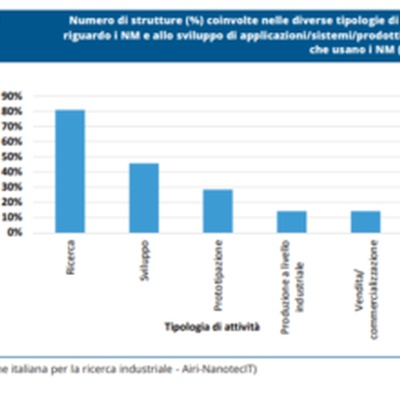
Most of the facilities are engaged in the R&D and prototyping phases,
a significant part of the activities underway on NM therefore involves R&D laboratories (and to a less significant extent production plants and sales networks).
The most used types of NM are nanoparticles or 0-D NM (55% of the structures),
followed by two-dimensional NMs (43%), and 1D NMs (22%).
The most frequently used NMs are metal oxides, followed by base NMs
carbon and nanopolymers, and metals.
R&D activities at national level on NMs and NTs have as their objectives a multitude of application sectors, including both typical areas of advanced manufacturing and areas linked to widely consumed products. Prevalent sectors include advanced materials and materials, chemicals, pharmaceuticals and health care, ICT, energy and environment.
Exposure to nanomaterials in the workplace:
Approximately 40% of R&D facilities in NM develop prototypes or
products being marketed or already placed on the market.
There is a large number of entities, public and also private, with specific R&D activities for the risk management of NM.
The majority of structures (60%) take into account the peculiarities related to the risk management of NMs, and therefore use specific procedures and approaches in this area.
General considerations:
Most of the structures involved in nanomaterials consider it extremely important to develop further risk assessment, prevention and management tools for nanomaterials, in particular: the study of health effects and the characterization of nanomaterials are the aspects considered most relevant. Furthermore, it is considered essential to develop techniques for measuring and monitoring exposure, the development of individual and collective protective devices, the education and training of workers, and the definition of specific safety procedures for nanomaterials. Finally, the issue of the environmental impact and waste disposal of nanomaterials is also of particular importance.
In reference to the NanoLab project, the investigation made it possible to evaluate the applicability of the NanoLabel methodology to contexts of research, development and production of nanomaterials, different from the case studies addressed by the project.
In reference to the NanoLab project, the investigation made it possible to evaluate the applicability of the NanoLabel methodology to contexts of research, development and production of nanomaterials, different from the case studies addressed by the project.
In NanoLab, Airi guaranteed the connection with the main national industrial research entities in the sector of enabling technologies, and the comparative analysis regarding the initiatives and activities on nanomaterials underway at national and European level. It has also contributed to the collection and dissemination of information, with the creation of workshops and events and other initiatives aimed at encouraging dialogue between industry, research, institutions and civil society.
Download the volume in PDF (the investigation is reported in chapter 4 from page 70 to page 90)
You may also be interested in the following content:
-
brand_awareness Priority Technologies: a unique foresight at the national level
-
brand_awareness Extra-mural R&D in 2014 grows to 2.4 billion euros
-
brand_awareness Three calls for research projects in Argentina